THE RECEIPT · Week 4 · 2026
Published · Historical Week 4 record
Receipt: The Chargers Still Owe Their Offense a Clean Test
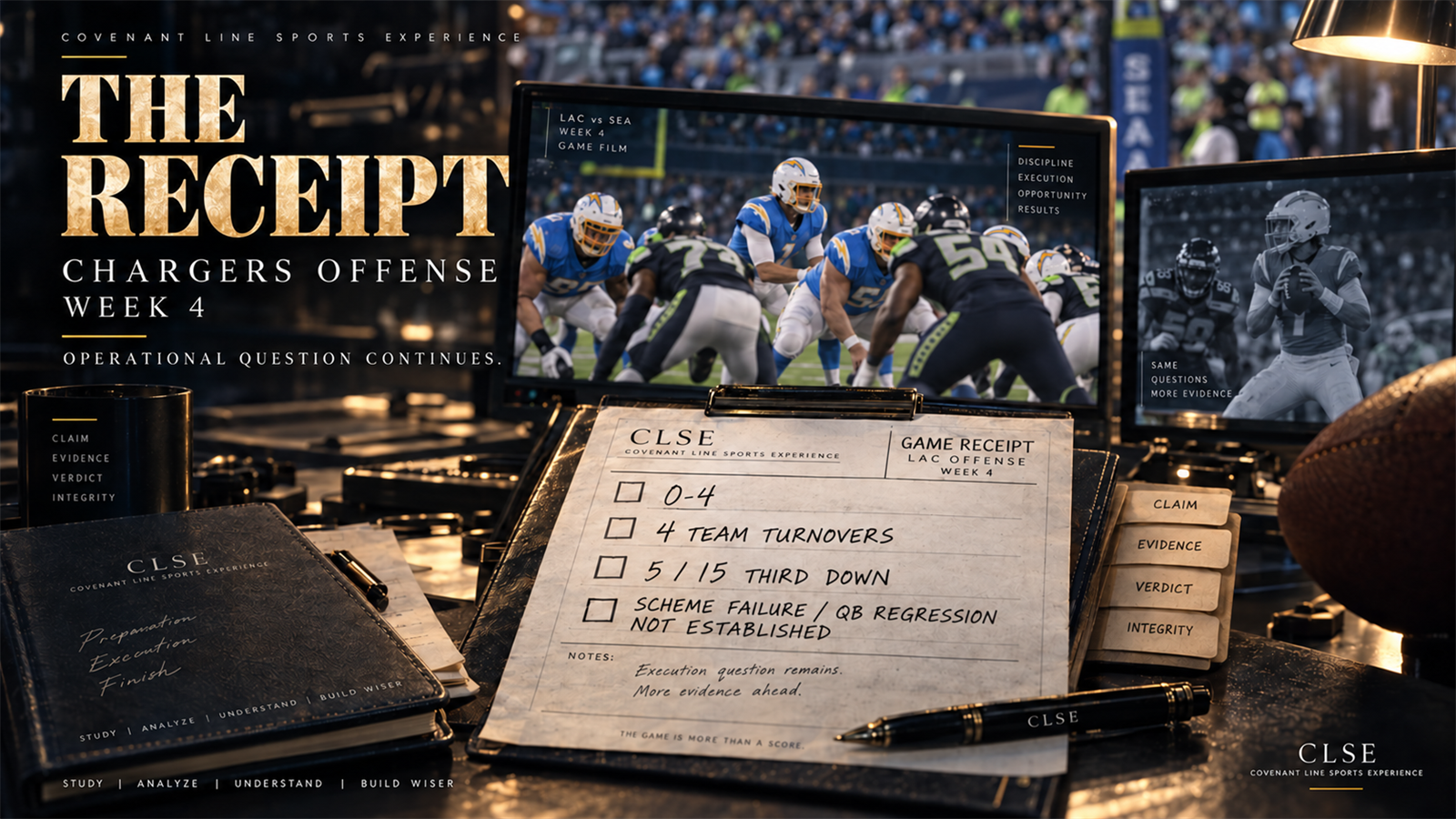
The earlier CLM finding asked whether operational errors were preventing the Chargers offense from giving its design a clean chance. Week 4 supplies another bounded test, but not a clean one.
The official Chargers recap documents two first-half interceptions, a special-teams muffed punt, and a final lost strip-sack fumble. It also records five third-down conversions in fifteen attempts. Los Angeles lost 30-23 and fell to 0-4.
That evidence keeps the operational question open. It does not isolate scheme failure. It does not establish quarterback regression. It does not prove that the offense cannot work. It says the receipt is still unpaid: the structure has not yet received a materially clean evaluation.
The turnover count must stay precise. CLSE is treating the four events as team-turnover evidence because one was a special-teams muff, not an offensive turnover. The unbound penalty total is omitted from this package because exact official source binding was not recovered in the accepted packet.
The second-half response and opponent effects remain part of the comparison. The useful test from here is not a stronger verdict. It is a cleaner game, followed by examination of what remains.
One more receipt. Same question.
What does the offense look like when the avoidable errors stop speaking louder than the structure?
Second Sight
Original thesis. New evidence. Same unresolved test.
- Original thesis
- Week 3 supported and strengthened the Week 2 finding that recurring operational breakdowns were preventing the offense from consistently giving its design a clean chance.
- Week 4 evidence
- W4 documented two first-half interceptions, a special-teams muffed punt, a late lost strip-sack fumble, and five third-down conversions in fifteen attempts.
- What changed
- Another game supplies attributable operational errors rather than a clean test of deeper limitations.
- What held
- The operational question stays open; scheme failure and quarterback regression remain unestablished.
- What is not established
- No scheme-failure, coaching-failure or quarterback-regression verdict. Turnovers are TEAM turnovers because the muffed punt is special teams. The unbound penalty total is omitted.
Retrospective owner review
The Chargers Receipt
November 8, 2026 · Chicago · Week 2 through Week 4 only
Original publication time: Not recovered. Original evidence cutoff: Not recovered.
RETROSPECTIVE / NOT_EVALUABLE · Not evaluable. Original timing and fixed evaluation conditions are not sufficiently recovered to score this as a prediction.
One accountability case, not a claim that the whole method is proven.
Supported within the original operational boundary; deeper structural question unresolved.
The original question. The later evidence. What remains open.
What we said
“the offense is not operating cleanly enough to consistently give its own design a chance.”
Excerpt from the recovered Week 2 manuscript. Full wording and the condensed public version remain distinct in the ledger.
What tested it
Week 3 supplies the clearest repeat of the original mechanism. Week 4 preserves the concern but adds mixed evidence rather than proving an identical failure.
The Receipt owner’s November 8 retrospective reassessment.
What held, changed, or remains open
- What held
- The original operational concern has attributable examples. Week 3 provides particularly strong evidence that pre-snap mistakes damaged a valuable scoring opportunity.
- What changed
- Week 4 broadens the observed damage toward ball security. It should not be presented as another verified repetition of the exact Week 3 false-start sequence.
- Mixed evidence
- Productive stretches and the Week 4 second-half response coexist with costly mistakes. Neither cancels the other.
- Still open
- How much inefficiency remained on otherwise clean possessions; the relative roles of protection, decisions, execution, play design and opponent defense; whether improvement would persist.
- Not established
- Scheme failure, McDaniel failure, Herbert regression, permanent offensive incapacity, or whole-method validity.
Next test
If Los Angeles cleans that up and the offense remains ineffective, the investigation moves deeper into the Blueprint. For now, the evidence doesn't permit that leap.
For any separately authorized follow-up, the needed evidence is a possession-level account distinguishing clean possessions from those damaged by identifiable execution errors, while retaining field position, protection, opponent and game-state context. Any new threshold or horizon must be declared before evaluation and labeled a new test—not attributed backward to Week 2.
Inspect the complete claim and evidence ledger
The original words
Recovered Week 2 manuscript
Fourteen points isn't the crack. Losing twice isn't the crack. A new offense struggling for two weeks isn't automatically a crack either. The investigation changes when the failure has an identifiable mechanism. After Week 1, Los Angeles knew what needed attention: cleaner pre-snap operation, better early-down efficiency and fewer situations where the offense defeated itself before third down even arrived. Then Week 2 arrived. Six fumbles. Three turnovers. Four penalties from one of the offensive line's cornerstone players. And on third-and-1, an errant snap collided with a player in motion. Those aren't identical mistakes. They're evidence of the same broader vulnerability: the offense is not operating cleanly enough to consistently give its own design a chance. That's the crack CLSE can establish today. Not McDaniel. Not Herbert. Not the entire offensive philosophy. The operation. If Los Angeles cleans that up and the offense remains ineffective, the investigation moves deeper into the Blueprint. For now, the evidence doesn't permit that leap.
Original publication time: Not recovered · Evidence cutoff: Not recovered
Condensed Week 2 public version
The recurring mechanism is operational: the offense is not consistently giving its own design a chance. The finding stops there. It does not assign the failure to Mike McDaniel, Justin Herbert or the entire offensive philosophy.
If Los Angeles cleans up its operation and remains ineffective, the investigation may move deeper into the Blueprint. Current evidence does not permit that leap.
Original publication time: Not recovered
Cleaner operation with continued ineffectiveness permits deeper investigation. No original numerical definition of clean, efficiency threshold, probability, prescribed sample length or forecast horizon has been recovered.
No separate original method-version identifier was recovered; the preserved manuscript and public projection are distinct text versions.
Preserved Week 1 and Week 2 observations remain available in the recovered record, but original cutoff, first delivery and source-version availability are not established. Current rereading cannot backfill those dates.
What each record adds
Week 2 — original finding
Official reporting records 14 points, three turnovers and six fumbles, only one of which was lost. It identifies three Joe Alt false starts, his holding penalty producing a safety, and a third-and-1 snap striking a player in motion. Opponent explosive plays and offensive-line disruption also appear in the report.
Concrete execution failures support the original operational concern. Six fumbles must not become six lost possessions; the loss cannot be assigned entirely to these mistakes.
Week 3 — first Receipt
Five defensive takeaways produced a touchdown and field goal after the first two, then no points after the next three. Los Angeles scored one touchdown on four red-zone trips. From second-and-goal at the 1: false start, zero-yard pass, false start, eight-yard completion, field goal.
The goal-line sequence directly repeats the pre-snap mechanism and strengthens the narrow original finding. Takeaways create opportunities; they do not make every resulting possession equally favorable or guarantee touchdowns.
Week 4 — second Receipt
The recap identifies two first-half interceptions, a special-teams muff and the final lost strip-sack: four team turnovers, comprising three offensive turnovers and one special-teams turnover. Los Angeles converted 5 of 15 third downs and outscored Seattle 17–10 after halftime in a 30–23 loss.
Ball-security damage continued. This does not independently prove repeated false starts, an identical pre-snap mechanism, or scheme failure. The second-half response is material contrary evidence against describing the offense as uniformly incapable.
Contrary evidence and excluded claims
- The Week 3 report describes substantially better operation for much of the game before detailing the damaging goal-line penalties. Recurrence at a critical moment does not establish uninterrupted dysfunction.
- The Week 4 second-half recovery remains relevant, while opponent actions and game state prevent clean attribution of the result to offensive operation alone.
- The Week 3 report’s separate assertion of exactly 16 points in every game conflicts with Week 2’s 14; that cumulative assertion is excluded.
- Week 4 narrative/scoring-summary distance inconsistencies are excluded.
- The unbound Week 4 penalty total remains omitted. Special-teams and defensive mistakes are not relabeled offensive evidence.
What the method captured—and could not establish
It captured a useful distinction between a disappointing result and observable damage to possessions. It also preserved restraint around assigning failure to a coach, quarterback or offensive philosophy.
The weakness is the undefined “clean test.” Without a specified evaluation window and observable criterion, repeated mistakes can keep the deeper question open indefinitely. This reassessment cannot repair that limitation retrospectively. It also cannot treat every interception, sack, penalty and special-teams mistake as one proven causal mechanism.
Sources and separate dates
These are current readings of official reports, not independently preserved gamebook or film adjudications. Displayed publication dates do not prove today’s page bytes match those originally consulted.
Source publication, retrieval, repository preservation and CLM publication are different clocks.
- Reassessment evidence retrieved (UTC)
- 2026-11-09T00:46:49.825Z
- Historical Week 4 artifact retrieved (UTC)
- 2026-10-07T13:15:09Z
- Original CLM publication time
- Not recovered
- Original evidence cutoff
- Not recovered
- Week 2 official takeaways
Source-displayed publication: September 20, 2026 · 6:40 PM · Timezone: Not specified
- Week 3 official takeaways
Source-displayed publication: September 27, 2026 · 3:21 PM · Timezone: Not specified
- Week 4 official recap
Source-displayed publication: October 4, 2026 · 4:45 PM · Timezone: Not specified
Cracks in the Blueprint · November 8, 2026 · Chicago
The operation-level historical position is recovered; its original timing and measurable prospective test are not.
Companion Cracks custody confirmation is attached; original first-public-serving time, original evidence cutoff, and original social/publication receipt remain unrecovered.